Wednesday, 4 December 2013

blowing your own trumpet? or something else?

Our translators translate from French - using several different versions - into Monkolé. I then check the Hebrew text against what we have in Monkolé. People sometimes ask me if it isn't good enough to simply translate from the French.

Here is just a small example of why I think we get a better translation if we compare it with the Hebrew. As we were translating II Samuel we came across several instances of the Israelites blowing a "trumpet". This had been translated from the French into Monkolé as "kãakãakĩ" and when I asked my translators what it was, to check, they said "a trumpet", and confirmed that it was a metallic instrument.

In Hebrew the word is (if I transliterate) "shofar", a ram's horn which is blown through to create a loud, carrying sound. And in Monkolé, a similar horn is called a "kuu". So where appropriate, we have been changing "kãakãakĩ" in our text to "kuu".

(I have just had a look in a few English versions out of interest and have found a lot of "trumpets" but one "horns"!)

Monday, 18 November 2013

where we live

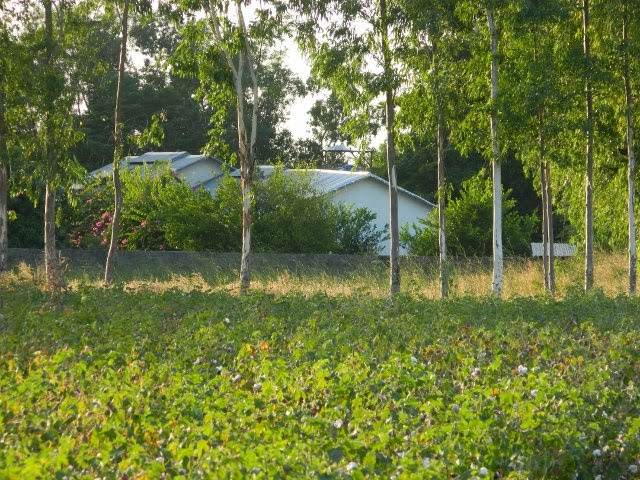
After posting my last post, I thought it would be good to show a few more photos of the landscape around where we live. The photos were taken at the beginning of this month - seen at another time of year the countryside would look very different!

Here is our house, seen across a field of cotton:


A view looking the other way, back over other fields (you may spot a "mountain" in the distance!):


Our happy African baby:


A cotton plant close up:


Saturday, 16 November 2013

making a mountain out of a molehill?

This post is not specifically about Bible translation, but more generally about the concepts behind the words we use.

In Monkolé it seems as if there is a word for "hill", "geete", and a word for "mountain", "iri kuta" (literally "head/top [of] stone"). However, the ideas behind the words are not necessarily the same as they are in English or French. I knew this already, but it was illustrated well in a conversation we had recently as we were working on translating 1 Samuel.

We came across the expression "was hiding in the mountains", and Philémon, the youngest of our team, looked slightly perplexed and said, "Hiding inside a cave or something, then."

"Not necessarily," I said.

He looked even more confused and said, "But if someone was just on a mountain, you'd see them straight away."

I realised that he was applying his idea of a mountain – shown here in a photo of a local "mountain":


Pastor Samuel, the older translator, said to him, "Oh no, what we have here aren't really mountains. In other countries they can be much much bigger."

"Yes, but still!" Philémon answered, and I realised he was just making the mountain five or ten times bigger in his mind.

This is when I am glad I have most of our photos on my computer. I found him this photo I'd taken in 2005 of Grenoble and the mountains beyond. I could almost see Philémon's understanding being widened as he answered, "Ah, ok, I understand now!"


While this was not a Bible translation problem as such, it does illustrate the way that any language tends only to describe what it needs to describe in the lives of the people who speak it. The Monkolé language has never needed to describe anything more than small hills … and this is the kind of difficulty we often come up against as we attempt to communicate the Biblical text faithfully. Recently we have been wrestling with the concept of "concubines". While polygamy is a way of life here, the idea of having full wives and then "second-rank wives" is totally foreign, and we still aren't entirely sure how to handle it.


Tuesday, 12 November 2013

speaking of clothes...

... I blogged a long time ago about how for special occasions a particular design of material is often chosen, and anyone involved can get clothes made from that material. So last April our whole family got clothes made for a wedding we were attending:


Another popular thing to do is to get T-shirts or polo shirts made for your event. So the first Sunday in November was "Women's Day" at church, and our church had this shirt made:


On the front it says "UEEB (the denomination) Women's Day - CEE (language grouping) Monkolé - 03/11/2013". On the back it quotes Proverbs 18:22, and I was pleased someone came to see me to check the validated translation of this verse. It also meant they got the spelling right!

Sadly, I wasn't here for the Women's Day service ... but I couldn't miss out on the shirt! Not my favourite colours, but it makes a good shirt to wear for work.

Monday, 11 November 2013

a colourful life?

I had a problem when I heard that for our last meal at our annual conference we were supposed to wear black and white! Back in Europe, our wardrobe was mainly filled with black, grey and dark blue clothes. But here in Benin, this is what it looks like:


Marc managed to find pale cream trousers and a black T-shirt, and I did remember I had one black top ... but I ended up with a purple and grey skirt, as I had nothing else black and white at all. Fortunately they still let me eat!

Wednesday, 30 October 2013

bread or a stone?

Eve was happily munching on a piece of bread at break, so I thought I could have a biscuit and we'd munch together. Hah! As soon as she saw my biscuit she threw her bread on the floor, and pointed to the box where her (special sugar-reduced) biscuits are kept.

Now I'm not against her eating biscuits as a general rule, but the bread was left over from breakfast, and I'm not going to let her skip breakfast and catch up on biscuits mid-morning. So I said, "No!" and rather meanly went on eating my biscuit. She wailed and whined and pointed her finger and furrowed her brow, and generally let me know how unhappy she was … and eventually took the piece of bread I held back out to her and went on munching as if she'd never stopped.

I think there are several things I can take away from this episode. One is just how much you can communicate without words. Another is that being firm can have the desired effect. And finally, the reassurance that our third child is healthily developing her sense of self and her personality!


Sunday, 27 October 2013

sights and smells

It is my favourite season of the year again. I am sure I have already blogged about just how much I love harmattan, but I am ready to annonce it again! The dry season here begins at some point in October, and the harmattan wind starts blowing at some point in the next weeks (usually November). This year it is starting early. One of the things I love is fresh lemons from our tree:


I'm sorry you can't smell the fresh lemon fragrance as we zest or squeeze these little orbs of zingyness!

I love the "monotony" of dry season weather. I never get fed up with knowing that every day will be bright and sunny. In harmattan, evenings and nights are cool, and mornings are fresh. So when the temperature mounts in the afternoon, it's never oppressive as you know it won't last long.

If I have to admit to not liking anything about dry season, then it must be the dust (which gets everywhere, in gradually increasing quantities) and the dry skin on my hands and lips. But I can put up with them*! And with a baby in cloth nappies, I love knowing that any washing will dry during the day.

* Though I do tend to let out a few yelps when fresh lemon juice hits the tiny cracks in my fingers!!