Monday, 6 October 2014

Tuesday, 23 September 2014
and breathe...
The translation team is currently
working through Numbers, and recently we arrived at 16:22, which in
one English version says:
“But Moses and Aaron fell facedown
and cried out, 'O God, God of the spirits of all mankind, will you be
angry with the entire assembly when only one man sins?'”
Translated literally back into English,
our Monkolé draft translation began the reported speech in this
verse, “God, because of whom everything exists ...”
Now in Hebrew it actually says
something like, “God, God of the spirits of all flesh”. “Spirit”
here is a word for spirit, breath or wind, and “flesh” is a word
which can apply to human beings and/or animals.
I felt that our translation was missing
the point. Moses and Aaron are afraid that in His anger God will kill
(even more of) the Israelites, and so they are reminding Him that
these people only have life/breath in them because He
gave it to them, and they are urging Him to think twice before taking
it away again.
One of
the problems was that in Monkolé the word for “lives” and
“exists” are the same, though in the above example from our first
draft translation it has to be “exists” since we are talking
about “everything”
(and not all things live). But we managed to get closer to the (I
believe) intended meaning by changing our translation to “God,
because of whom all living/breathing creatures live/exist”. It
isn't quite the same as the English because this translation chose to
understand “flesh” as meaning purely human beings. It would
actually be very hard to do this in Monkolé while keeping the idea
of “breath”/“life” so we have left it as all living/breathing
beings.
kids
The church kids' camp for which we translated 2 Kings 4 and 5 took place last week. There were 166 kids at it! Here are a few photos:


Thursday, 4 September 2014
a quick dip
The translation team is currently working through Numbers, but this week one of the church elders asked us if we could give them the text of 2 Kings 4 and 5 for the children's camp being held later this month. We said yes, of course!
So the beginning of this week was taken up with converting an old-format file of the draft version of 2 Kings into the format we now use, and then reading through and working on it to make it as accurate, readable and consistent (with other books) as possible. It is important that Elisha and Naaman's names are spelt the same way in 2 Kings and in Luke, that Carmel is spelt the same way everywhere it is mentioned and so on. We have words like "naa" and "na" which we need to try not to mix up, and we had to discuss whether certain sentences were better worded as questions or as affirmations.
In Hebrew Elisha is called the "man of God" in many parts of these chapters, but in Monkolé that just sounded weird, so we put "prophet of God" instead. And we had several discussions about where an extra "i" should be added onto the end of a word ... it sort of gives focus to the sentence ... but I never have much to add to these particular debates, which really need native Monkolé speakers!
We had some interesting discussions as we worked, particularly about Gehazi's behaviour in 2 Kings 5:20-2 (I'll leave you to look it up if you're interested!).
Thursday, 21 August 2014
ironing
Sometimes I liken my work to ironing. A lot of what I do is trying to smooth out "creases". Correcting spelling mistakes and typos, making sure that names of people and places are spelled the same way every time they appear, making sure we have consistent vocabulary and so on. Sometimes it is frustrating to come across old drafts which are very "wrinkled", but there is a certain satisfaction in working on them and seeing them become flat and pristine.
The ironic thing is that in the real world I hate ironing!
Friday, 15 August 2014
14th August 2004
Our marriage is ten years young...


"We love because he first loved us." I John 4:l9
"We love because he first loved us." I John 4:l9
Wednesday, 30 July 2014
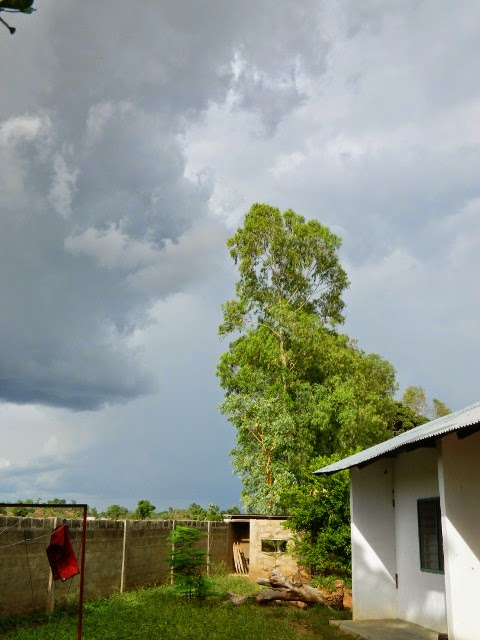
schizophrenic sky
I wish I had a wider-angle lense, because the further left you looked, the blacker the cloud became ... and it's a pity you can't hear the rumbles of thunder too! The other funny thing is that the cloud was moving towards me, so one side of the sky remained blue, while this huge thundercloud loomed overhead ... or at least on the righthand side of overhead!

Saturday, 26 July 2014
Leviticus. Check!
I am happy to report that our week of checking ended with us finishing Leviticus - with just ten minutes to spare! Halfway through the week I really wasn't sure we'd make it, but it is always a tidy feeling to finish a week with a completed book. At the same time, the most important thing is to do the work well, so we'd never rush it just to be able to say we'd got it done.
I always have mixed feelings about our checking weeks. My team is great, and works really well with our consultant, Pierre, so I always enjoy the time we spend together. The work is intellectually challenging, and yet at the same time if there are no problems with our translation then I'm not actively doing anything except listening, which requires a lot of concentration.
I have to work fulltime during these weeks, and while that isn't a problem from the point of view of the work, I do miss spending time with my kids!
Translation work doesn't make for the most exciting photos. To make a change, I asked Marc to take a photo of us during a coffee break this last week. From left to right: me, Philémon, Pastor Samuel and our consultant, Pierre.


Thursday, 24 July 2014
what missionaries do in their time off...
(What?! Missionaries get time off?)
This is Family Fun Day - hosted by TWR and enjoyed by missionaries and ex-pats living in Benin...


Monday, 7 July 2014
Anniversary joy!
This Sunday, Pastor Samuel and his wife Hélène invited the whole church to celebrate their 30th wedding anniversary with them after the service. They had made fish sandwiches and hot chocolate for everyone - quite a feat! - and it was wonderful to see the smiles on their faces. They are such lovely people, and such a great example of what marriage can be when two people serve God together.


Wednesday, 18 June 2014
computers and clouds
Last week the translation team attended a workshop about our translation computer programme, Paratext, in Parakou. Here you can see all the participants (except me!):

And here are Pastor Samuel and Philémon listening intently:

Back in the office this week, and I'm all on my own as my translators are taking their annual leave...

... but working on three computers at once. Perhaps it's because I was afraid the computers would get lonely ... or perhaps I thought it would stop me from feeling too lonely ... or maybe it is just that after last week's workshop I wanted to get all our computer files up to date!
The translators have taken their annual leave to go and work in their fields, preparing the ground and planting. The rains have started, and so we are seeing lots of skies like these (both photos taken today):

(It's a pity about the electric wires getting in the way, especially since they do us no good at all!)
Tuesday, 3 June 2014
tired eyes?
Last week we were working on Job chapter 31 and in verse 16 the Hebrew speaks of Job (hypothetically) causing the eyes of the widow to fail. The idea is that she would have hoped to receive charity from him which never came.
One of the French versions says "si j'ai laissé les yeux de la veuve s'épuiser", "if I let the widow's eyes become exhausted". This seems to be what gave the Monkolé draft which said, "mà ǹ nɔ ǹ jɔ̀ jaaɔ̃ gɔ í cɔ sim kpãai ngɔgɔ hee ijuɛ í gbɛɛji", literally "or did I let a widow hope* something from me until her eye was tired". As we worked through the draft together, one of my translators said, "we'll have to take out the words 'her eye', because eyes can't get tired [in Monkolé], only people can" but the other translator said, "or we can leave 'her eye', but say 'was dry'".
So our version now has the widow watching until her eye is dry. I love these little details which should make our Bible sound more Monkolé!
*And as an added note, "to hope" in Monkolé is "to watch the path"
Friday, 23 May 2014
Scenes from our travels
A few things we saw on our most recent travels. Firstly, a lorry which had broken down completely blocking the road! Apparently he knew he was running out of diesel, thought he'd turn around and go back to Parakou ... and ran out entirely while turning round! Here he is:

The taxi which stopped in front of us opened its boot to give the sheep some air:

This is a bus we saw as we left Parakou the next day, which presumably doesn't belong to a French football team any more...

This is the kind of thing we see far too much of:

You can carry anything on the back of a motorbike (though presumably it was empty!):

And this is what we actually see during most of our journey down the country. Frankly not all that interesting!

Monday, 19 May 2014
double wedding
We attended a double wedding in the village last Saturday. Here is the first bridegroom, waiting for his bride ... the veiled woman in the chair next to him is an older lady who is just teasing him!

The second couple after the brides had arrived. I mentioned once before that such a solemn occasion means that couples don't smile during the ceremony - very strange for us!

A "where's Wally?" moment - see if you can spot the missionaries in the crowd:

A big thank-you to the Director of SIM France, Jean Salmeron, who was visiting us and took these photos.
Saturday, 17 May 2014
why?
I am sometimes asked, respectfully, whether it is really necessary to translate the Bible into
local languages when "most people" speak French. After all,
if sermons can be translated on-the-spot, couldn't the same be done
with the Bible?
My first answer to this is actually a
question. Do you understand everything you read in the Bible when you
read it in your mother tongue? I suspect the answer to this will be
no, or else you are avoiding the bits you don't like! And if the
answer is no, then why add a layer of difficulty for Bible readers by
demanding that they read it in their second language?
My second, and similar, answer comes
from my experience as a member of a Bible translation team. I have a
lot of respect for my colleagues on the team, and if you spoke with
them in French you would find them competent speakers. But that is
very different from understanding the nuances, rhetoric and irony of
a literary text in another language. Some of the drafts we've worked
on (and it may have been previous translators who originally
translated them) read like they've been translated by a computer. The
vocabulary seems about right, but the meaning is garbled.
So that is why I think it is important
that people have the Bible in their own language. If nothing else, if
they don't understand the text, it is important that they know that
it is the text itself which is difficult to understand. If they
suspect that it is their own lack of fluency in their second language
which is a preventing them from understanding God's word, it
discourages them from even trying.
As an example of mis-use of a second
language, the youth of our church, who are educated in French,
recently made themselves a T-shirt exhorting others to "Sois un
modèle à égard." Not only is this a
misquote of the Bible (probably based on I Tim.
4:12 or Titus 2:6-7) it is bad French which you would have
thought someone would have noticed before getting however many tens
of T-shirts printed. It does make you wonder whether they actually
understand the sentence, or at least more than the first three words.
Often when reading in another language, we are convinced we
understand, but our understanding is based on assumptions and
expectations rather than the actual words (this happens too of
course, though to a lesser extent, in our first language).
And a quotation which has another take
on the question:
The greatest missionary is the
Bible in the mother tongue. It needs no furlough and is never
considered a foreigner. —William Cameron Townsend
Wednesday, 30 April 2014
tiny fufu dabii
Further to my last post, I thought I would share that Eve's new nickname is "fufu dabii", due to her unpredictable but determined path around the house, and her tendancy to pick up small objects on her way and drop them randomly several metres further on...

Apologies for the slight fuzziness, she often moves too fast for the camera to focus!
Monday, 21 April 2014
wandering wind
One of the tell-tale signs of hot season are dust devils, kind of like mini-whirlwinds (there is an interesting article on wikipedia if you want more details on what they are!). Most of them we see are under a metre wide and just a few metres high, but occasionally a larger one whips through our property sending dust flying (we run round trying to shut all windows if we can!).
In Monkolé they are called "fufu dabii" (= wandering wind) and people are wary of them. Some people try to throw stones at them to make them go away, and there is a belief that firing a gun into them will "kill" them.
We saw this bigger one a few weeks ago:

Friday, 18 April 2014
on being try-lingual... (part 2)
More answers to questions I was asked by my friend's students:
Your personal
perspective:
Which language do you
feel is more useful/ important to you?
It depends on the
situation! I can't imagine not speaking my mother tongue to my
children. But because I met and got to know my husband in France
speaking French, I like speaking French with him, and it reminds me
of our “roots”, especially since we are no longer in France. For
my Bible translation work, Hebrew, Monkolé and French are essential,
and English is extremely useful.
Which do you feel you
can express yourself best in? Do you ‘think’ in all of them?
I don't feel handicapped
in French compared to English. I know that some people say that when
they are angry or upset they can only express themselves effectively
in their mother tongue, but I don't find that. Monkolé is a lot more
difficult, partly because I have been learning it for a shorter time
(4 years), and partly because there is a whole very different
mentality and culture behind it. But that makes it all the more
fascinating to learn! Sometimes someone says something, and even
though you understand all the individual words you don't understand
what they mean put together, or the point of what they are saying.
I definitely think in both
English and French, depending on the situation and the people I'm
with. I assume I must think in Monkolé when I'm speaking it, as I
don't translate from another language to speak it.
For example, once when our consultant
was with us, and we were working in French, I looked up and from our office window I saw some
people arriving at our house. Without thinking I exclaimed in
Monkolé, “Oh, it's the X family! They said they'd be calling in
today, and I completely forgot...” then suddenly switched to French
to say to our consultant, “Oops, sorry!” as he doesn't speak
Monkolé. My other two colleagues with whom I do speak Monkolé were
present, and I can only assume that somehow my brain “tuned in”
to them, or else to the environment of our office, which is usually a
totally Monkolé-speaking zone to me!
Friday, 11 April 2014
birds
After my photos of flowers, here are a couple of the birds we've seen recently in our compound. Firstly a red-billed hornbill:

Brown(?) babblers:

(Thanks to Marc for the photos and my parents for the identification!)
Subscribe to:
Posts (Atom)
