Tuesday, 22 May 2012

hello baby!

Since we have been in Benin, we have had a number of particularly note-worthy cross-cultural experiences, such as my interesting time passing the Beninese driving test. We have also braved the dentist, and now we're venturing into another domain of the medical system. I am pregnant, due mid-November, and so at the end of last month when we were in Parakou we went to see a gynaecologist for a check-up and a scan.


It is a private practice, though I suspect he works at the hospital during the daytime, and so one turns up at 7 in the evening, takes a number, and waits for one's turn! A 2-hour wait in our case! Fortunately someone was babysitting our boys and so we had no worries about time. The waiting room was hot, there was a noisy overhead fan which didn't help much, and a television which showed death notices for a lot of the time we were there.

The gynaecologist was great. He felt like someone you could trust and who knew what he was doing. And the scan was better quality than I had allowed myself to hope for. The long wait was forgotten in the joy of seeing our baby for the first time, waving lazily at us! The gynaecologist was happy with the scan and allowed us to take both photos and a video with our phone! (There was in fact a print-out, but the phone photo was clearer.)

And here he or she is, Baby Deneuf #3: 

Wednesday, 16 May 2012

changing seasons


We have survived hot season and are now going through the most turbulent season of the year, weather-wise! As hot season gives way to rainy season, we have violent storms, which begin as dust-storms before the rain takes over.
 
Here are a few photos from last week. First the dust:


And then the rain, which entertained the boys for quite some time!


The next day was beautiful!


On Sunday night we had a thunderstorm and then constant rain all night … it didn't finish drizzling until about ten o'clock in the morning, and then we had light showers from time to time all day. It really felt like rainy season, and obviously the pastor's wife thought so, as she decided it was time to start planting our garden. Simon and Benjy have their own small hoes, and Simon in particular really got stuck into working with his:

Sunday, 29 April 2012

Paratext in Parakou!

The translation team has just got back from a training course held in Parakou on the use of Bible translation software called Paratext. It was an inspiring few days! The new (to us) software is a programme which makes it possible to open on one computer screen several different versions of the biblical text being translated (the Hebrew/Greek, French translations, English translations …) with a window in which the translation is typed. Settings can be controlled so that the text is immediately formatted ready for printing, which is very helpful.

We have only had the elementary training so that we can do the basics. Once we have some experience using it we're hoping to carry on with more training, as it is in fact very complex software with very useful applications!

A few photos (thanks to my colleague Dodi Forsberg):


The other wonderful thing about the training course was a few days away in the relative cool of Parakou. At home we have “lows” at night of 30°C and during the day the temperature goes above 40°C. So it was lovely to have cool nights and to even be in an air-conditioned room for our training!

Sunday, 8 April 2012

fire and flames


This is a common sight in dry season. People set controlled fires to prevent wild bush fires from sweeping through inhabited areas. This photo was taken from our kitchen window, the wall in front of the flames being our new wall-around-the-property-compound.


This is also the time of year when the flame trees come into bloom - what a feast of colour!


Friday, 23 March 2012

even more building!!

One of the blessings of missionary life is the variety of people we get to know. Not only our fellow “longtermers” (missionaries who are out here for more than two years) but also those who come for a shorter period of time. Recently we have had Peter, a Swiss short-termer, staying with us to help with some of the building. He is mainly based at a hospital an hour and a half away, but came up to help to put a roof on the “paillotte” here on the Pèdè mission property.

Peter:


Actually, he originally came up to help with the built-in cupboards, but our carpenter didn't turn up when he said he would, so Peter helped out with varnishing some window frames. We have loved having Peter around – he's easy-going, flexible and great with the boys. We're also grateful for his work, and his willingness to do any job, no matter how small!

One downside of missionary life is the goodbyes, but Peter is in Benin until the end of April, so we're bound to bump into him again … and he's also told us we're always welcome to visit him in Switzerland!

Peter working with the roofers who came to put a roof on the paillotte:


They finally let him get a bit higher off the ground:


The finished product:


Friday, 9 March 2012

Dry Season Bible School 2012

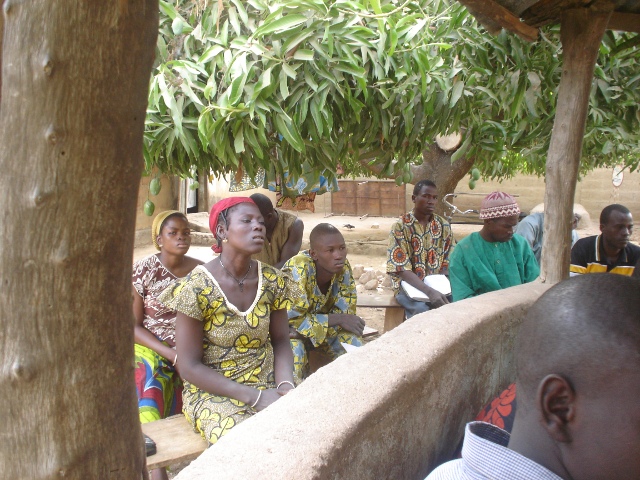
Sitting in Dry Season Bible School I have a feeling of nostalgia. Our second month here in the village of Pèdè, two years ago, was spent at Bible School. Our predecessor, Grace, was teaching, with Pastor Samuel. We were encouraged to see that we understood words here and there, and could follow to some extent if we knew which Bible passage was being talked about. Two years on, it is reassuring to see that instead of understanding about 10%, we probably understand over 70% (though it is hard to evaluate exactly!). And of course Marc is even teaching, which really is an achievement!

As I sit on the concrete bench in the open air (we are under an open-sided kind of hut, with some more students under a nearby mango tree) I certainly know I'm in Africa. It sounds clichéd, but there really are sheep wandering around, lizards scurrying by, and the sound of yams being pounded. The atmosphere is good – the students (a good cross-section of the men of the church, plus some of the younger women and one older lady) are attentive, at least until the end of the morning when the heat intensifies. They ask questions, and tease each other in a friendly manner. There was some chuckling yesterday when one of the students asked, “But why did God rest on the seventh day? Surely He wasn't tired!”

I can't get to the start of Bible School each day, as I have to wait for the pastor's wife to get here to look after the boys. But in fact this works out well, as I then go to the office for an hour or so to do some Hebrew revision and prepare some training exercises for our newest translator, then go down to Bible School during their break, and attend the two sessions before lunch. While it is a positive sign that I understand 70% or so (and nearly 100% when my husband is teaching!), it does mean I still have progress to make, and listening to the teaching does stretch me.

We are thankful for prayer for all the teachers and participants of Dry Season Bible School. It is quite a big sacrifice to give up so much time and energy, especially at a hot time of year. May all be rewarded by a greater understanding of God's Word and a closer walk with Him. (It will be running until March 23rd.)

This is actually a photo from 2 years ago, but nothing much has changed...


Sunday, 4 March 2012

fathers or parents in general...?

Just something that came up in the translation work recently. It was a small point, and not a problem for us, but it did make me think about the way different languages work.

In Zechariah 10:7 there is a sentence which is either translated as “their children shall see it and rejoice” or “their sons shall see it and rejoice”. In Hebrew there is no problem with using the masculine plural form to include both male and female. It is true that a little earlier, in Zechariah 8:5, the text does speak of “boys and girls”, therefore not using the masculine plural for both, but on the other hand “sons of Israel” is often used in the Hebrew Bible to speak of the whole people of Israel, not just the men.

When you are translating into another language though, if that language doesn't work the same way as Hebrew, you have to decide whether the Hebrew form meant male-and-female or just male. An interesting example, actually from the Greek this time, came up when we were at Bible College. We were looking at the verse in Ephesians which says, in the NIV, “Fathers, do not exasperate your children: instead, bring them up in the training and instruction of the Lord.” (Eph. 6:4)

The lecturer said, simply as an aside, that of course in the Greek, a masculine plural could include male and female, and so it would probably be better translated as “Parents”. I was taken aback. I had, honestly, always read this verse as applying to male parents, without stopping to ask myself whether that was realistic. (Not that I didn't think it was true for mothers, I just thought in this case Paul was particularly addressing the fathers.) In my defence, in the British English I speak, you would never say “fathers” if you were talking about fathers-and-mothers, you would always say “parents”. So is this a slip-up on the part of the NIV, or are they speaking a different version of English from me, or did they judge that actually these words of Paul were only for male parents?

Another detail. In Zechariah 10:8, God says that He will whistle for His people and will gather them. In Monkolé “whistle” has just been translated by “call” … I guess whistling may not mean the same thing in Monkolé as it does in Hebrew. And actually, even in English it could seem a bit derogatory, like whistling for one's dog. I doubt many English people would come to you if you whistled to them! A good example of a place where a literal translation is not necessarily the most comprehensible nor the most appropriate.

Afterthought: After having written this, I was actually hissed at in the market by a woman I am acquainted with, who wanted to greet me. Interesting...!