Thursday, 24 July 2014

what missionaries do in their time off...


(What?! Missionaries get time off?)

This is Family Fun Day - hosted by TWR and enjoyed by missionaries and ex-pats living in Benin...


Monday, 7 July 2014

Anniversary joy!

This Sunday, Pastor Samuel and his wife Hélène invited the whole church to celebrate their 30th wedding anniversary with them after the service. They had made fish sandwiches and hot chocolate for everyone - quite a feat! - and it was wonderful to see the smiles on their faces. They are such lovely people, and such a great example of what marriage can be when two people serve God together.


Wednesday, 18 June 2014

computers and clouds

Last week the translation team attended a workshop about our translation computer programme, Paratext, in Parakou. Here you can see all the participants (except me!):


And here are Pastor Samuel and Philémon listening intently:


Back in the office this week, and I'm all on my own as my translators are taking their annual leave...


... but working on three computers at once. Perhaps it's because I was afraid the computers would get lonely ... or perhaps I thought it would stop me from feeling too lonely ... or maybe it is just that after last week's workshop I wanted to get all our computer files up to date!

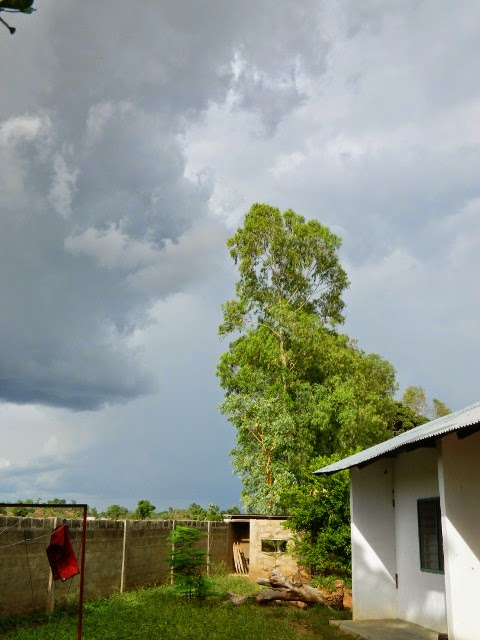
The translators have taken their annual leave to go and work in their fields, preparing the ground and planting. The rains have started, and so we are seeing lots of skies like these (both photos taken today):


(It's a pity about the electric wires getting in the way, especially since they do us no good at all!)

Tuesday, 3 June 2014

tired eyes?

Last week we were working on Job chapter 31 and in verse 16 the Hebrew speaks of Job (hypothetically) causing the eyes of the widow to fail. The idea is that she would have hoped to receive charity from him which never came.

One of the French versions says "si j'ai laissé les yeux de la veuve s'épuiser", "if I let the widow's eyes become exhausted". This seems to be what gave the Monkolé draft which said, "mà ǹ nɔ ǹ jɔ̀ jaaɔ̃ gɔ í cɔ sim kpãai ngɔgɔ hee ijuɛ í gbɛɛji", literally "or did I let a widow hope* something from me until her eye was tired". As we worked through the draft together, one of my translators said, "we'll have to take out the words 'her eye', because eyes can't get tired [in Monkolé], only people can" but the other translator said, "or we can leave 'her eye', but say 'was dry'".

So our version now has the widow watching until her eye is dry. I love these little details which should make our Bible sound more Monkolé!

*And as an added note, "to hope" in Monkolé is "to watch the path"


Friday, 23 May 2014

Scenes from our travels

A few things we saw on our most recent travels. Firstly, a lorry which had broken down completely blocking the road! Apparently he knew he was running out of diesel, thought he'd turn around and go back to Parakou ... and ran out entirely while turning round! Here he is:


The taxi which stopped in front of us opened its boot to give the sheep some air:


This is a bus we saw as we left Parakou the next day, which presumably doesn't belong to a French football team any more...


This is the kind of thing we see far too much of:


You can carry anything on the back of a motorbike (though presumably it was empty!):


And this is what we actually see during most of our journey down the country. Frankly not all that interesting!


Monday, 19 May 2014

double wedding

We attended a double wedding in the village last Saturday. Here is the first bridegroom, waiting for his bride ... the veiled woman in the chair next to him is an older lady who is just teasing him!


The second couple after the brides had arrived. I mentioned once before that such a solemn occasion means that couples don't smile during the ceremony - very strange for us!


A "where's Wally?" moment - see if you can spot the missionaries in the crowd:


A big thank-you to the Director of SIM France, Jean Salmeron, who was visiting us and took these photos.

Saturday, 17 May 2014

why?

I am sometimes asked, respectfully, whether it is really necessary to translate the Bible into local languages when "most people" speak French. After all, if sermons can be translated on-the-spot, couldn't the same be done with the Bible?

My first answer to this is actually a question. Do you understand everything you read in the Bible when you read it in your mother tongue? I suspect the answer to this will be no, or else you are avoiding the bits you don't like! And if the answer is no, then why add a layer of difficulty for Bible readers by demanding that they read it in their second language?

My second, and similar, answer comes from my experience as a member of a Bible translation team. I have a lot of respect for my colleagues on the team, and if you spoke with them in French you would find them competent speakers. But that is very different from understanding the nuances, rhetoric and irony of a literary text in another language. Some of the drafts we've worked on (and it may have been previous translators who originally translated them) read like they've been translated by a computer. The vocabulary seems about right, but the meaning is garbled.

So that is why I think it is important that people have the Bible in their own language. If nothing else, if they don't understand the text, it is important that they know that it is the text itself which is difficult to understand. If they suspect that it is their own lack of fluency in their second language which is a preventing them from understanding God's word, it discourages them from even trying.

As an example of mis-use of a second language, the youth of our church, who are educated in French, recently made themselves a T-shirt exhorting others to "Sois un modèle à égard." Not only is this a misquote of the Bible (probably based on I Tim. 4:12 or Titus 2:6-7) it is bad French which you would have thought someone would have noticed before getting however many tens of T-shirts printed. It does make you wonder whether they actually understand the sentence, or at least more than the first three words. Often when reading in another language, we are convinced we understand, but our understanding is based on assumptions and expectations rather than the actual words (this happens too of course, though to a lesser extent, in our first language).

And a quotation which has another take on the question:

The greatest missionary is the Bible in the mother tongue. It needs no furlough and is never considered a foreigner. —William Cameron Townsend