Saturday, 16 March 2013

marching on ...

The month of March is always a bit different for us here in the village, as the Monkolé churches hold their Dry Season Bible School. Three Bible teachers offer classes open to all Monkolé believers, held every morning. This year they are being held on the mission property, as we finished off work on a « paillotte » (open air structure) in January. The work was begun by the Longworth family in 2009, the roof went up last year, and this year we were able to put in a floor and stone benches.

We also had a special visit from an international speaker (!), Marc's father Jean-Louis. He came to Benin for a little under two weeks for a teaching tour around some rural churches who don't often get outside speakers. His first stop was two mornings teaching here to get our Bible School started. Here are Marc, Jean-Louis and some of the Monkolé Christians:


This month is also unexpectedly different for me. In October we were very pleased to welcome a young Swiss man who said he wanted to come and help a missionary family. He was to carry out his Swiss civil service by homeschooling Simon in the mornings – thus freeing up extra ministry time for Marc – and tutoring secondary school pupils in Kandi in his afternoons. We knew that of course this would mean that Marc would spend some time mentoring him and supervising his work. We hadn't realised just how difficult this might be.

Eventually we had to take him off Simon's homeschooling. Despite Marc's help and advice, he simply wasn't taking it seriously, and we felt it wasn't fair on Simon. He wasn't following the programme properly and was leaving silly mistakes uncorrected in Simon's work. This was of course a big disappointment to us, not so much for the extra time Marc lost, but because someone we trusted and were counting on didn't live up to our expectations.

While Marc is teaching Bible School this month, I have taken over Simon's schooling. Marc had told me how good the CNED course was, and I'm now discovering that for myself. It is a distance schooling course offered by the French government, and subsidized for French citizens living abroad. All the materials are supplied – tutor's manual, pupil's manual and all ressources – and it is all very well explained. Simon enjoys learning, despite a tendency to block if he doesn't get something right first time, and he is therefore a pleasure to teach most of the time!

Of course, the course is in French, and Simon is used to speaking English with me. But since it is only for a few weeks I figure it doesn't matter too much if we mix the languages. So all the official school stuff we do in French, but remarks like "Where's my ruler?" or "I think you know the answer to this one!" usually come out in English!

Sunday, 10 March 2013

in the village ... and at home

Even at her young age, Eve has started getting made-to-measure clothes. Here she is in the village, being fitted for her latest outfit.


These photos also illustrate that although we feel at home here, we'll never be « just like everyone else ». Our village is sufficiently big that if we are down in the village there'll always be someone fascinated to see the « baturé » (white) people, and a white baby is even more of a draw. And kids will cluster round until one of the adults yells at them to give us some space!

Another thing I am often quite aware of which makes us different from everyone else is that we don't have the same support systems. Every mother of young children here has countless sisters, cousins, aunts etc. who she can rely on to help her out. Of course, we have friends in the village, and help in the house/with the kids (though only during my work time) and if it were a real emergency I'm sure we'd find help. But for the day-to-day stuff, it does sometimes feel like we are juggling a whole lot of balls (more so than if we were in Europe where gadgets would do some of it, and we would at least have 24/7 electricity!).

Wednesday, 20 February 2013

Quickie

Since the connection is working this evening, I feel I should at least post to say that we are having a great week with our translation consultant. As of this afternoon (Wed) we have finished checking Zechariah, and we are going to get stuck into Jonah tomorrow! The consultant is very happy with our work, which is also good news!

Thursday, 31 January 2013

Getting up-to-date


(Written 22nd January but I couldn't post it before now!)

Sorry about the long silence, due to small baby disruption and a dodgy internet connection! The internet connection has got a bit better recently – for which we are thankful – and the small baby is currently asleep, so I now have no excuse not to blog!

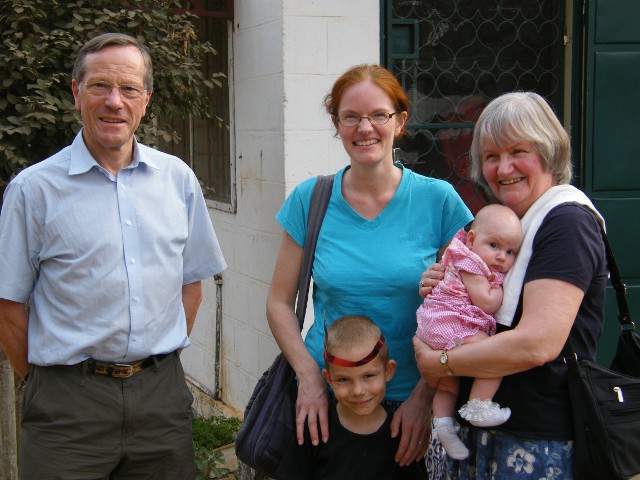
Maternity leave has gone quickly what with Simon's birthday, Christmas, New Year and my parents' visit to us. Here are my parents with me, Simon and Eve in Parakou.


I'll be starting work again on February 4th. I have been into the office a few times to pray with my translators and keep track of their work. In fact here is a photo taken by my dad yesterday, in which I'm helping Pastor Samuel with a computer problem:


The great thing about working so close to home is that I won't have to worry too much about going back to work and breastfeeding. There would be no point taking time out of work to express my milk when the baby can come to me!


Friday, 21 December 2012

no hair and no earrings!


The two things which are most commented on in the village as regards Eve are her lack of hair and earrings. Her lack of hair is sometimes put down to us having shaved it off - something which people here do if their baby has a lot of hair - but they are slightly doubtful whether we'd do that at the coolest time of year. I explain that no, all three of our babies were born with very little hair, and they shouldn't expect to see Eve with much hair for quite some time!

People also ask me why we didn't get her ears pierced. I explain that at home it is quite rare to pierce babies' ears, and that she'll probably get them pierced when she's older. When I said I was fourteen years old when I had mine done, I got a puzzled look and an attempt to correct me with, "Four months?" "No no, fourteen years!" Someone else present exclaimed, "Then how do you tell boys and girls apart?" and I explained that hairstyle or clothes usually indicate it.

Blue for boys and pink for girls isn't a custom here. Another missionary friend was asked whether her baby was a boy or a girl, and when she answered "a boy", was presented with a little pink and white sparkly pyjama outfit.

One thing I do appreciate about people in our village is that they may exclaim over differences, but generally they don't tell me I'm doing things wrong. Another example is that I've been told that if I were Beninese I would wrap Eve up a lot warmer (ie. woolly jumpers and hats even in 25°C heat) but they seem to accept that that's not what we do, and that she doesn't seem to be suffering for it. I do put a little cotton hat on her if we're going out in the mornings, as I don't want to shock people too much by seeing her little hairless head exposed when they are feeling cold! And I did put several layers on her to go to church, but ended up having to peel some of them off as she was getting hot and sweaty and was squeaking in protest!

People are also interested by my sling, since babies are carried on women's backs here. But again, if I explain that this way she can hear my heart beating and I can see her, they understand. I have started to carry her on my back occasionally, but I'm slightly nervous of the process of getting her onto my back, since it involves her starting off lying on my back with nothing holding her there!

In the sling:

Friday, 7 December 2012

Photos of Eve's first Sunday at church


These photos were taken by the church photographer on the day we "presented" Eve to the church. The pastor here is Pastor Samuel with whom I work in the translation team.

Saturday, 1 December 2012

new arrival meets the village

While maternity leave means that I am not directly doing translation work at the moment, having a new baby has made us feel part of the community in new ways. First of all, we have had visits from people who want to congratulate us and meet the new arrival.

Secondly, we welcomed Eve into the church family last Sunday. Traditionally among the Monkolé people, a new mother stays in her house for 8 days with her baby. When she comes out, there is a ceremony called « ama ku fita », which means « bringing the child out ». There are various rites to be carried out as a way of bringing the child into the community. The church use the name « ama ku nyisi », meaning « showing the child », and now Christians present their baby to the church, thank God publicly for the gift of their child, and the church prays for the child and parents. We were happy to be able to do this for Eve, and felt loved and encouraged by our Monkolé brothers and sisters as we did so.

We also needed to start Eve's vaccinations. The first one is the BCG, and Marc and I went to the local hospital in Kandi last week, where at the entrance we bumped into two women from our church. It turned out that one of them, Marie, had given birth a week after me (also to her third), and she had come to the hospital for the same reason as us, only to be told that since there was a meningitis vaccination campaign going on, the BCG wouldn't be given until the next week.

So in the end Marie and I took our babies down to the hospital together this week. I always get a bit frustrated at the medical system here, as it is difficult to understand how things work, so going with someone who worked at the hospital was definitely a bonus! We had to wait for an hour, while things got set up and some pregnant women were given the injection, and then we were seen first. To be fair, we had been among the first to arrive, but we did also have the double advantage of Marie being an insider and me being white. We should be able to have the following vaccinations done in the village, by a team who come out once a week from a health centre.

I was glad to have someone to wait with, too, and it was good to chat in Monkolé to someone who I don't know so well. And I don't generally have all that much contact with other women my age in the village. So we were able to talk about our children, our birth experiences, Marie's work as a nurse and so on.

Next vaccinations around December 20th ("Happy Christmas, Eve!")